Choosing a motorcycle with a Type 2 charging port starts with more than checking the connector shape. Type 2 Charge Port Motorcycles can offer convenient AC charging, but the port alone does not tell you how quickly the bike will charge. Look for the onboard charger’s rated power, the battery’s usable capacity, and the charging limits stated by the manufacturer. A familiar plug is only part of the picture.
Picture a weekday stop beside a public AC charger. The cable fits, but the motorcycle may draw less power than the charger can provide. Check the owner’s manual or manufacturer’s specifications for supported voltage, current, and charging equipment. Confirm whether a cable is included and whether any adapter is explicitly approved. Charging times can vary with battery temperature, state of charge, and the charger’s output. Small details matter.
Range deserves the same careful attention. Compare real-world reports with official figures, and consider your usual speed, passenger load, hills, and weather. A short commute and a long rural ride ask different things from a battery. Ask about battery warranty, service access, and replacement costs before you buy. These are practical questions, not fine print to ignore.
Be cautious with broad claims. Two motorcycles with the same port may have very different charging performance. And advertised range may not match your route. If possible, inspect the charging screen and port in person, then ask a dealer to explain the specifications in writing. It can feel like too much checking. Still, a few careful questions can prevent an expensive mismatch.
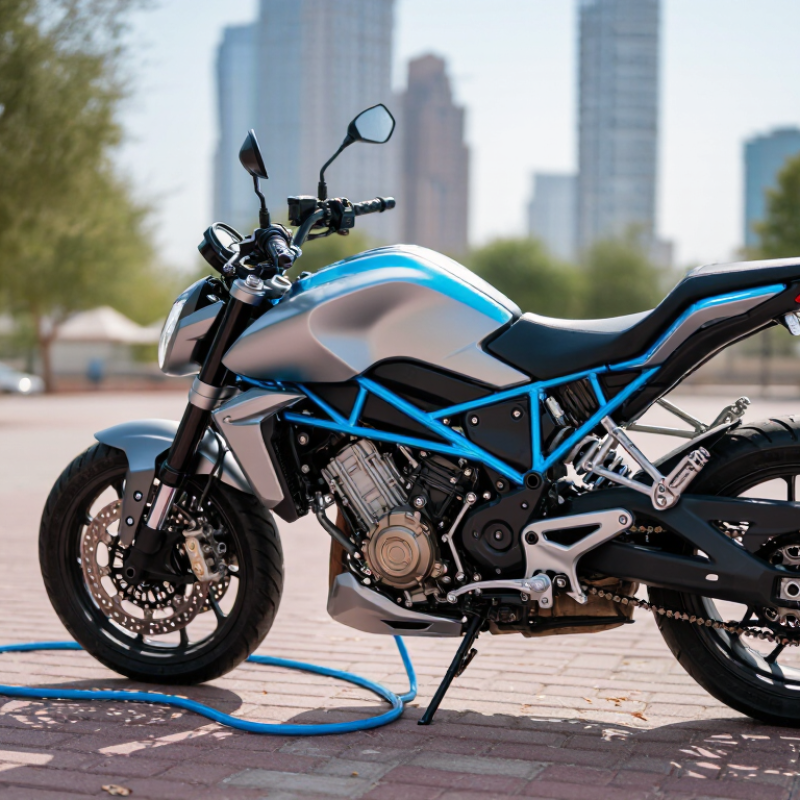
How to Choose a Motorcycle with a Type 2 Charge Port?
Under IEC 62196-2, Type 2 describes an AC connector’s shape and contact arrangement. It is not a DC charging port. With AC charging, power enters the motorcycle and its onboard charger converts it for the battery. That distinction matters when comparing specifications. A matching socket does not guarantee fast charging or even full compatibility. Check the owner’s manual or technical sheet for the inlet type and the onboard charger’s AC limits. Small detail. Big consequence.
Look for the maximum AC input in kilowatts, plus the supported voltage and current. Then confirm that the charging cable has the correct connector at both ends. A charging station’s Type 2 socket alone cannot tell you how quickly the motorcycle will charge. If a model also supports DC charging, verify that separately; DC requires a suitable inlet and charging system. Inspect the port diagram and protective cover, too. A sales label can be vague, and I would not rely on a product photo alone. One thing is easy to overlook: charging speed may be limited by the motorcycle, even when the supply can deliver more.
| What to Check | What It Means | How to Use It When Choosing |
|---|---|---|
| Connector standard | Type 2 is the AC vehicle connector defined by IEC 62196-2. The connector shape alone does not indicate that a motorcycle supports DC fast charging. | Confirm that the specifications explicitly identify the vehicle inlet as Type 2 AC. Check separately whether the motorcycle has a distinct DC charging inlet. |
| AC charging capability | AC from a charging station is converted to battery-compatible DC by the motorcycle’s onboard charger. | Look up the onboard charger’s maximum AC input power and supported phase configuration. The vehicle, not just the cable or charging station, determines the usable charging rate. |
| Common AC power levels | At nominal European supply voltages, 230 V × 32 A is about 7.4 kW for single-phase AC. A 400 V three-phase supply at 16 A is about 11 kW; at 32 A it is about 22 kW. | Treat these as supply-side examples, not guaranteed motorcycle charging rates. A motorcycle with a lower-rated onboard charger will charge below the station’s available output. |
| Type 2 contacts | The Type 2 interface provides contacts for AC power and protective earth, plus control and proximity signaling. Three-phase connections can use L1, L2 and L3; single-phase charging typically uses one phase. | Use the vehicle manual or official technical specifications to verify the inlet and its supported supply. Do not rely only on a picture or a seller’s description. |
| Cable and charging station | Many public AC stations with Type 2 sockets require a compatible Mode 3 cable. Some stations have a permanently attached cable instead. | Check whether the motorcycle includes a cable, what connector is on each end, and whether it is rated for the intended current and phase configuration. |
| DC fast charging | DC charging supplies power to the battery through a DC charging system; it is not established merely by having a Type 2 AC inlet. DC charging uses a compatible DC inlet and vehicle charging system. | If fast charging is important, verify the exact DC standard, maximum DC power and inlet shown in the motorcycle’s documentation. Do not assume a Type 2 AC port accepts DC. |
| Charging time | A rough estimate is usable battery capacity (kWh) divided by the actual charging power (kW). Real charging can take longer because of conversion losses, temperature and charging limits. | Compare battery capacity with the onboard charger’s rating, and use the manufacturer’s stated charging times for a more reliable estimate. |
| Home and regional compatibility | Charging-station connectors, household supplies and electrical rules vary by country. A Type 2 inlet does not by itself guarantee compatibility with every home outlet or charging point. | Confirm local connector availability, required cables or approved equipment, supply voltage, and any installation requirements before purchase. |
| Safety and weather protection | Ingress protection, charging interlocks and permitted charging conditions are specific to the motorcycle and its equipment. | Check the owner’s manual for the inlet’s protection rating, safe handling instructions and restrictions on charging in wet conditions. |
Key buying rule: Identify the inlet standard, then verify the motorcycle’s onboard AC charger and any separate DC capability in its technical documentation. A Type 2 connector is an AC interface; its presence alone does not mean the motorcycle supports DC charging.
It identifies an AC connector shape and contact arrangement under IEC 62196-2. It is not a DC port.
No. Charging speed depends on the motorcycle’s onboard charger and its AC power limits. The socket alone tells little.
Check the maximum AC input, supported voltage, current, and inlet type. A clear technical sheet helps.
Only if its onboard charger accepts three-phase AC at that rate. The charging equipment must also provide three phases.
It will draw no more than about 6 kW from an 11 kW supply. The supply cannot raise the motorcycle’s limit.
Not by itself. DC charging needs a suitable inlet and charging system. Check those specifications separately.
Confirm the connector at both cable ends and check its rating. Inspect the port diagram and protective cover, too.
I wouldn’t rely on either alone. Ask whether the quoted charging time assumes three-phase power. Details can be oddly unclear.
When comparing Type 2 Charge Port Motorcycles, first confirm that the inlet follows IEC 62196-2 and is designed for AC charging. A Type 2 connector is not a DC charging port, so the motorcycle’s onboard charger determines how much AC power it can accept. At 230 V, a 16 A supply provides about 3.7 kW, while 32 A provides about 7.4 kW, if the onboard charger supports those levels. Three-phase charging may reach roughly 11 kW at 400 V and 16 A, but only when the motorcycle and charging equipment support it.
Estimate charging time by dividing the usable battery capacity in kilowatt-hours by the actual AC input power in kilowatts, allowing extra time for charging losses and any reduction in power during charging. Before use, check that the EVSE, cable, and any adapter are compatible with the motorcycle and meet the relevant IEC 61851-1 and IEC 62196-2 requirements.