Small Batch Electric Motorcycles are no longer a niche idea, but sourcing them still demands careful proof. The International Energy Agency’s Global EV Outlook 2024 reports nearly 14 million electric two- and three-wheelers sold worldwide in 2023. That figure signals scale, not guaranteed demand for every model. A small-batch buyer must still verify who builds the motor, where cells come from, and whether replacement parts will remain available.
Battery benchmarks help, but they can mislead. BloombergNEF reported an average lithium-ion pack price of $115 per kilowatt-hour in 2024, after a 20% annual decline. That is a market-wide benchmark, not a supplier’s landed price for a motorcycle pack. Ask for a written bill of materials, cell documentation, test results, warranty terms, and sample-unit performance. Check details you can see: connector fit, cable routing, weld consistency, and the label on the charger. Small things matter.
IEA Executive Director Fatih Birol has emphasized the need for diversified, resilient critical-mineral supply chains. For this guide, the practical takeaway is simple: verify suppliers beyond their sales pitch. Start with a prototype, test it under real riding conditions, and confirm the factory can reproduce the same build in later batches. Then review minimum order quantities, lead times, spare-parts support, and quality controls. The first sample may be excellent. The second production run may not be. That possibility deserves an honest place in any sourcing plan.
Define the buyer before you contact suppliers. A delivery rider, campus operator, and weekend commuter need different machines. Write down the route length, typical daily distance, road surface, payload, parking conditions, and charging access. Be specific. “Urban use” is too broad to guide a useful specification. A five-kilometer route with steep ramps may demand different range and torque than a flat, thirty-kilometer commute. Talk to likely riders, then check your assumptions against real trips. Early interviews can be wrong; that is useful information, not a reason to ignore them.
Turn the use case into a small-batch brief. State the target quantity, preferred delivery window, expected battery range, motor output, braking needs, and any required accessories. Ask which parts are standard and which require custom work. Request sample-unit pricing, production lead times, quality checks, warranty terms, and availability of replacement parts. Compare written specifications rather than relying on broad claims. For a small order, a supplier’s ability to document inspection steps and resolve defects can matter as much as the quoted unit price. Keep a little room for revision; first estimates rarely capture every detail.
Small-batch sourcing is a capacity-matching exercise, not a search for the biggest factory. The International Energy Agency’s Global EV Outlook 2024 reports that electric two- and three-wheeler sales reached about 13 million in 2023, roughly one-fifth of global sales. Demand is real. But headline volume does not prove a plant can build your configuration reliably.
Ask each candidate for monthly output by model, current utilization, minimum order quantity, and changeover time. Request a dated production schedule, not a brochure estimate. Check whether frame welding, painting, final assembly, and end-of-line testing happen in-house or through subcontractors. A pilot batch can expose bottlenecks: battery-pack matching, harness rework, and missing fasteners may slow production. Have the factory share recent, anonymized build records. Trace one sample motorcycle from incoming cells to final inspection.
The same IEA report estimates global battery-cell manufacturing capacity exceeded 2.5 terawatt-hours in 2023, but broad supply does not guarantee small, correctly specified packs. Ask for cell-source records, pack test results, and the monthly capacity reserved for your order. Capacity claims can still be optimistic. Add a modest schedule buffer, then review it against the first production run.
How to Source Small Batch Electric Motorcycles in 2026
Before ordering, confirm the exact motorcycle meets the standards of its intended market. Ask for model-specific conformity records, lighting and braking specifications, and clear evidence of applicable type approval. Requirements can differ between regions and vehicle categories. A certificate for a similar model may not cover your configuration. I would not treat a tidy PDF as proof. Have an independent inspector compare the documents with the frame markings and fitted components.
Battery paperwork deserves equal scrutiny. Request the UN 38.3 test summary for the battery type, plus its safety data sheet and shipping details. These documents relate to transport; they do not establish every aspect of vehicle safety. Check pack traceability, battery-management protections, charger compatibility, and procedures for damaged units. A sample ride helps, but it has limits. Ask how the supplier tests charging and records faults, then verify those claims where practical.
Import rules can affect cost and delivery dates. Confirm tariff classification, duties, required declarations, labeling, and any local registration or inspection steps with the relevant authorities or a qualified customs broker. Get written confirmation before paying a deposit, especially when a shipment includes separate batteries or chargers. Small batches magnify errors. A missed document or incompatible plug can turn a promising purchase into an expensive delay.
EU two-wheel vehicle classes set power limits that can help screen a motorcycle before you request type-approval documents.
How to use this chart: Under EU Regulation (EU) No 168/2013, L1e-B mopeds are limited to 4 kW and a maximum design speed of 45 km/h; L3e-A1 motorcycles are limited to 11 kW; and L3e-A2 motorcycles to 35 kW. These are class screening limits, not a substitute for checking the vehicle’s full type-approval documentation. For battery shipments, request the applicable UN 38.3 test summary. Confirm homologation, customs documentation, and duties with the destination market’s authorities or a qualified customs broker.
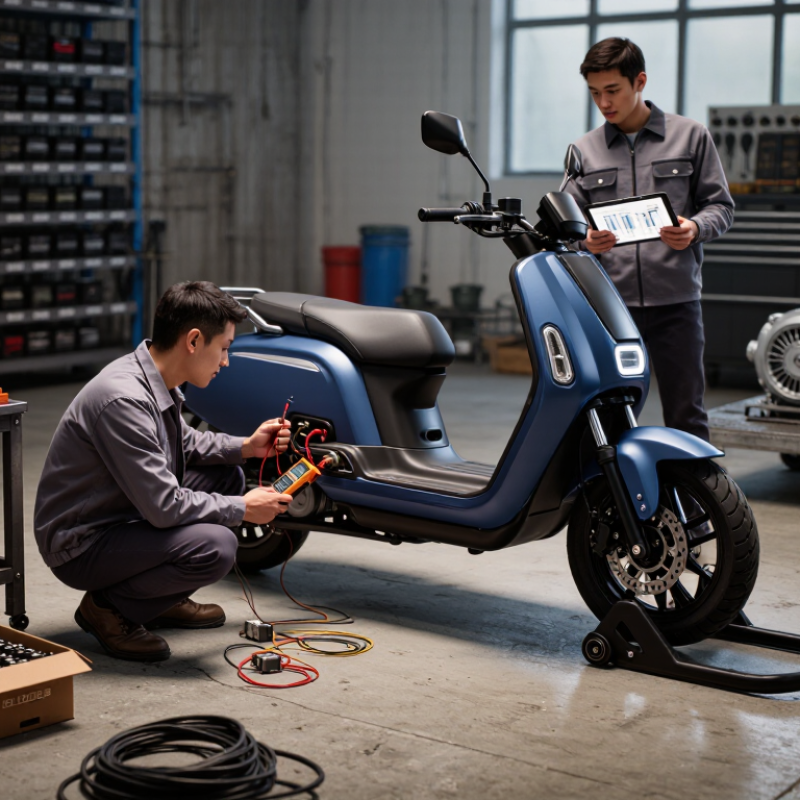
A sample should match the configuration intended for production, not just look convincing in photographs. Ask for its motor, battery, controller, charger, and connector specifications. Record the serial number and test conditions. Inspect welds, cable routing, fasteners, and weather seals under bright light. Then ride the motorcycle on repeatable routes, including a hill, several stops, and a rough patch of pavement. Track battery use, braking feel, and unusual heat after the ride. Small differences matter. A polished prototype can still hide inconsistent assembly; that is easy to overlook.
Before ordering, request a written quality-control plan. It should explain incoming component checks, torque verification, electrical tests, and final road testing. Ask how faults are recorded and corrected, and whether each unit can be traced to its inspection results. Set measurable acceptance criteria, such as allowable alignment variation or a required brake test. Do not rely on photos alone. If an independent inspection is practical, use one before shipment. For a small batch, the extra cost may feel excessive, but a missed defect can be harder to manage later.
After-sales support deserves the same scrutiny as the sample. Confirm response times, warranty coverage, diagnostic steps, and the availability of replacement parts. Ask which parts can be shipped quickly and which require longer lead times. Request a service manual and clear fault codes before committing. That sounds obvious. It is not. Test the support process with a specific technical question, and note how clearly the supplier answers. A vague reply is useful information too.
Use these indicative planning benchmarks to compare suppliers. Requirements vary by vehicle category, destination market, battery configuration, and order size; confirm applicable regulations and test plans before placing an order.
| Stage | Evaluation Dimension | Practical Benchmark | How to Verify | Warning Signs |
|---|---|---|---|---|
| Supplier screening | Small-batch order terms | Request written pricing at several quantities, such as 5, 10, and 25 units. Confirm minimum order, production lead time, payment milestones, packaging, and spare-parts terms. | Compare like-for-like quotations and obtain a signed specification and purchase agreement before paying a deposit. | Unclear delivery dates, changing specifications, or pressure to pay the full balance before inspection. |
| Sample evaluation | Sample lead time and configuration | Allow roughly 2–6 weeks for a configured sample as an initial planning range. The sample should match the proposed production battery, motor, controller, brakes, tires, and display. | Record component part numbers and photograph the sample. Compare the approved build sheet with the delivered vehicle. | A sample uses different components from the quoted production configuration, with no written change approval. |
| Sample evaluation | Road and functional checks | Check starting, acceleration, braking, steering, lighting, horn, display, charging, and operation at low and normal speeds. Test on a controlled route appropriate to the vehicle. | Use a documented checklist; record faults, charging behavior, range-test conditions, and any unusual noise, heat, or vibration. | Intermittent electrical faults, inconsistent braking, loose fasteners, or performance claims that cannot be reproduced. |
| Battery and safety | Battery documentation and protection | Request battery specifications, cell and pack identification, charger compatibility, protection-system details, and applicable transport documentation. UN 38.3 test evidence is commonly relevant to lithium-battery transport. | Match documents to the exact battery model and configuration. Confirm market-specific vehicle and electrical requirements with a qualified compliance specialist. | Documents refer to a different battery, incomplete traceability, or no clear process for damaged or returned batteries. |
| Quality control | Pre-shipment inspection plan | Agree on checks for appearance, key dimensions, fasteners, electrical functions, charging, brakes, and included accessories. Define defect categories and acceptance rules in writing. | Use an independent inspection where practical, with photographs, serial-number records, and a signed inspection report before final payment. | Inspection scope is vague, defects are not classified, or the supplier refuses to document corrective actions. |
| Quality control | Production consistency and traceability | Require a final bill of materials, revision control, serial-number tracking, and written approval for component substitutions. For sampling, define the inspection method and acceptance criteria in advance. | Compare production units against the approved sample and specification. Keep records linking each unit to its battery and major components. | Unapproved substitutions, missing serial records, or production units that differ materially from the approved sample. |
| After-sales support | Warranty and claim handling | Specify warranty duration, covered parts, labor responsibility, claim evidence, response time, shipping costs, and remedies. Set separate terms for battery capacity loss and other battery faults. | Ask for a written claim workflow and test it with a sample service question before ordering. | Warranty exclusions are undefined, response commitments are absent, or every claim requires returning the complete vehicle at the buyer’s expense. |
| After-sales support | Spare parts and technical information | Agree on a starter parts list covering likely service items, such as brake components, controls, displays, chargers, tires, and electrical connectors. Request service instructions and wiring information. | Confirm part numbers, availability, replenishment lead times, and whether parts remain compatible across production revisions. | Parts have no identifiers, technical information is withheld, or replacement components cannot be confirmed before shipment. |
| Order decision | Pilot-batch readiness | Place a limited pilot order only after sample approval, compliance review, quality criteria, delivery terms, and after-sales responsibilities are documented. | Use a signed approval record and review pilot-batch defects and service issues before increasing order volume. | Scaling up is requested before the pilot has been inspected and its issues resolved. |
For a small-batch electric motorcycle order, agree on the unit price and what it includes before approving production. Ask for separate line items for batteries, chargers, packaging, spare parts, and freight. A low quote can hide tooling or inspection charges. Confirm the currency, quote expiry, deposit, and balance-payment triggers. Tie final payment to a written inspection record, not just a promised ship date. Specify acceptable finish, battery capacity, and test documents. Small batches amplify every delay.
Tips: Put the quantity, configuration, price, and permitted substitutions in one signed order sheet. Define how changes affect cost and timing. Clarify who books freight, insures the shipment, and prepares export paperwork. Include a defect-report window and a stated remedy. “Standard terms” can mean different things to each party.
Build delivery schedules around milestones: drawing approval, parts procurement, assembly, factory testing, and dispatch. Request calendar dates and regular updates, such as a weekly status note with photos of packed units. Agree how delays are reported and whether partial shipments are acceptable. Leave room for battery checks and transport handoffs. Schedules can still slip; this part is never perfectly predictable. Buyers may focus on factory completion and overlook transit time. Record the delivery point and when responsibility transfers, so delays can be discussed using specific dates.
Describe the riders, route length, daily distance, road surface, payload, parking, and charging access. A five-kilometer hill route differs from a flat commute. “Urban use” is too vague.
State the quantity, delivery window, expected range, motor output, braking needs, and accessories. Ask which parts are standard and which need custom work. Keep room for revisions.
Ask how range was tested, including rider weight and terrain. Compare it with actual trips on similar roads. Early estimates can be wrong.
It should match the planned production configuration, not just its photographs. Record the serial number and component specifications. Small details matter.
Inspect welds, cables, fasteners, and weather seals under bright light. Ride repeatable routes with a hill, several stops, and rough pavement. Track battery use and braking feel.
Ask for a written plan covering component checks, torque verification, electrical tests, and final road testing. Set measurable acceptance criteria. Do not rely on photos alone.
Confirm response times, warranty coverage, diagnostic steps, and replacement-part availability. Request a service manual and fault codes. Test the process with one technical question.
Approve only after testing the sample and reviewing inspection records. An independent inspection may add cost, but missed defects can be harder to manage. My first specification may still be wrong.
Sourcing Small Batch Electric Motorcycles in 2026 starts with a clear definition of your target market, intended riding conditions, and expected order volume. Specify the range, performance, design, and features you need, then look for manufacturers whose production capacity and customization options fit a limited initial run. A focused brief helps suppliers provide more accurate quotes and makes it easier to compare proposals.
Before placing an order, check that the motorcycles meet the standards and import requirements relevant to your destination, and request clear documentation on battery safety. Evaluate samples for performance, build quality, and consistency, while also reviewing the supplier’s quality-control process, warranty terms, spare-parts availability, and after-sales support. Finally, agree in writing on pricing, payment milestones, minimum quantities, delivery schedules, and how changes or delays will be handled. Careful preparation can reduce sourcing risks and help your first batch arrive ready for its intended market.